What Sensors and Technology Are Connected to Your Windshield?
The exact equipment varies considerably by vehicle.
A basic windshield may have few additional features, while another vehicle may combine several technologies around the glass and rearview-mirror area.
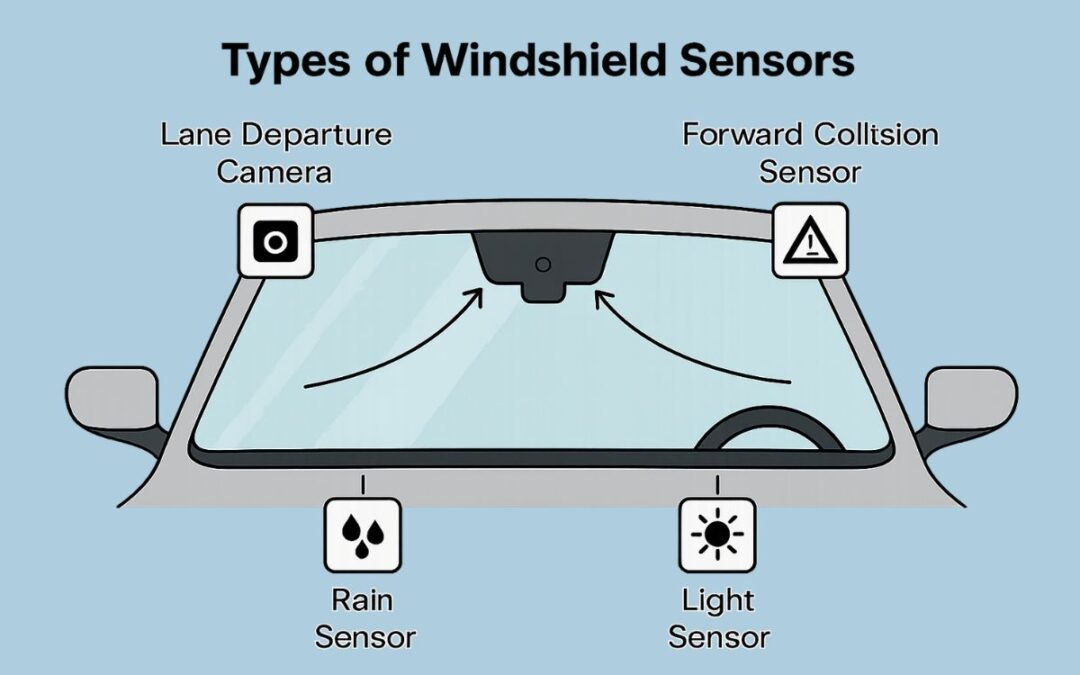
Common examples include rain sensors, ambient-light sensors, forward-facing ADAS cameras, heating elements, antennas, and specialized glass designed for a heads-up display.
Because equipment varies by year, make, model, trim, and options, two windshields that look nearly identical may not necessarily be interchangeable.
That is why professional Windshield Replacement begins with identifying the vehicle and the correct glass configuration.
Rain Sensors: How Your Windshield Knows It’s Raining
If your windshield wipers automatically activate when rain begins, your vehicle may have a rain sensor.
The sensor is commonly positioned against or near the inside surface of the windshield around the rearview-mirror area. Rather than simply detecting that the exterior is wet, many rain-sensing systems use optical principles to detect changes caused by moisture on the glass.
The vehicle can then activate the wipers and adjust their operation based on the system’s interpretation of rainfall.
Since the sensor works in conjunction with the windshield, correct positioning and the appropriate glass area matter.
A replacement windshield should therefore match the requirements of the vehicle rather than simply fitting the opening.
Light Sensors and Automatic Headlights
Some vehicles also use ambient-light sensing to control automatic headlights or other lighting functions.
Depending on the design, this functionality may be incorporated into an assembly near the windshield or combined with other sensor equipment.
Again, not every vehicle uses the same configuration.
This is why identifying windshield technology should be vehicle-specific instead of assuming that every housing behind a rearview mirror contains the same components.
Forward-Facing ADAS Cameras
One of the most important windshield-related technologies on modern vehicles is the forward-facing camera.
It is commonly mounted near the rearview mirror and looks through a designated area of the windshield toward the road.
Depending on the vehicle, information from this camera may support features such as lane departure warning, lane keeping assistance, forward collision warning, traffic sign recognition, or automatic emergency braking.
However, the exact functions vary.
A vehicle may have some of these features and not others. Furthermore, different manufacturers can use different combinations of cameras, radar, ultrasonic sensors, and other technology to accomplish similar driver-assistance functions.
The windshield camera should therefore be considered part of a larger system rather than a standalone sensor that performs every ADAS function.
How Lane Departure Warning Works Through Your Windshield
Lane Departure Warning is a useful example of why windshield technology matters.
On many equipped vehicles, a forward-facing camera observes lane markings through the windshield. The vehicle processes that visual information to help determine its position within the lane.
If the system detects an unintended departure under the conditions in which it is designed to operate, it may provide a warning to the driver.
Because the camera looks through the windshield, glass selection, installation, camera positioning, and applicable calibration procedures can become important when the windshield is replaced.
For a deeper explanation, see How Lane Departure Warning Works Through Your Windshield.
Are Forward Collision Sensors Actually in the Windshield?
Not necessarily.
This is an important distinction because the phrase “forward collision sensor” can make it sound as though a single sensor is located inside the windshield.
In reality, forward-collision and automatic emergency braking systems can use different combinations of technology.
A forward-facing camera near the windshield may contribute visual information. Meanwhile, radar or other sensors can be mounted elsewhere on the vehicle.
Therefore, replacing a windshield does not mean every sensor involved in a collision-avoidance system has been removed or disturbed.
Instead, technicians need to identify the equipment associated specifically with that vehicle and follow applicable procedures.
Is a Heads-Up Display a Windshield Sensor?
No. A heads-up display, or HUD, is better described as windshield-related technology rather than a sensor.
Sensors and cameras collect information.
A heads-up display presents information to the driver by projecting it into the driver’s viewing area.
Vehicles equipped with HUD systems may require windshield glass designed to display that projection correctly. Using glass that does not match the vehicle’s specifications could affect how the projected image appears.
This distinction is another example of why a modern windshield cannot always be selected by dimensions alone.
What Is the Black Box Behind Your Rearview Mirror?
If your vehicle has a large plastic housing behind or around the rearview mirror, you may wonder what is inside it.
There is no universal answer.
Depending on the vehicle, the housing may contain or cover a forward-facing camera, rain or light sensors, mounting brackets, wiring, or other driver-assistance equipment.
Some vehicles have a relatively small assembly, while others use a larger housing containing multiple components.
The owner’s manual can help identify features installed on your particular vehicle.
How Can You Tell if Your Windshield Has Sensors?
Start by looking around the rearview mirror from inside the vehicle.
A visible camera lens or plastic housing can indicate windshield-related equipment. Rain-sensing wiper settings, lane departure warning, lane keeping assistance, or similar driver-assistance features are additional clues.
You can also review the vehicle’s owner’s manual.
However, visual inspection alone does not always identify every windshield option.
When requesting auto glass service, provide the year, make, model, trim when known, and VIN when requested. This information can help identify the appropriate windshield and equipment configuration.
Why Does the Correct Replacement Windshield Matter?
Two pieces of glass may have nearly identical dimensions while supporting different vehicle features.
Depending on the vehicle, replacement windshields can differ because of camera mounting provisions, designated sensor areas, acoustic layers, solar coatings, heating elements, antennas, heads-up display compatibility, tint, or shade bands.
Consequently, ordering glass based only on the vehicle’s general model name may not provide enough information.
The correct windshield should match the applicable vehicle specifications and equipment.
This becomes particularly important for vehicles with camera-based driver-assistance systems because the camera must be able to view the road through the appropriate area of the installed glass.
Do Windshield Sensors Need Calibration After Replacement?
Some windshield-mounted ADAS cameras require calibration after windshield replacement according to vehicle-specific procedures.
However, not every windshield replacement requires ADAS calibration.
Requirements depend on the vehicle, installed equipment, affected camera or sensor systems, and manufacturer procedures.
When calibration is required, professional ADAS Calibration helps address the relationship between the camera and the vehicle after the windshield installation.
Depending on the manufacturer and system, the required procedure may involve static calibration, dynamic calibration, or another specified process.
What Happens if a Windshield Camera Isn’t Calibrated Correctly?
ADAS cameras depend on accurate positioning and system setup to perform their intended functions.
If an applicable camera requires calibration following windshield replacement, skipping the required procedure can leave the system outside the manufacturer’s specified calibration process.
The exact consequences vary by vehicle and system.
Rather than assuming a dashboard warning will always appear, the appropriate approach is to identify and complete the procedures specified for that vehicle.
For a more detailed explanation, see What Happens If You Skip ADAS Calibration After Windshield Replacement?
Does Every Windshield Replacement Need ADAS Calibration?
No.
Older vehicles and many vehicles without windshield-mounted ADAS cameras may not have an applicable camera calibration requirement.
Even among newer vehicles, requirements differ.
The determining factors are the vehicle’s actual equipment and manufacturer procedures, not simply the age of the vehicle.
If you see a camera housing near the rearview mirror or know that your vehicle has features such as Lane Departure Warning, mention those features when requesting windshield replacement.
Can a Windshield Chip Affect Sensors or Cameras?
Location matters.
A chip or crack within the viewing area of a forward-facing camera deserves particular attention because the camera relies on a clear optical path through the windshield.
However, that does not mean every chip automatically causes an ADAS malfunction.
Damage should be evaluated according to its location, extent, windshield construction, and vehicle requirements.
Some qualifying damage may be suitable for Auto Glass Chip Repair, while more extensive cracking or unsuitable damage may require replacement.
Addressing a small chip early can also reduce the chance that it spreads into a larger crack.
Can You Replace a Windshield With Sensors Using Regular Glass?
The replacement windshield should match the specifications and applicable features required for the vehicle.
Physical size alone is not enough.
A vehicle requiring camera mounting provisions, a specialized optical area, HUD-compatible glass, heating elements, or another specific feature should receive glass appropriate for that configuration.
This is one reason VIN information can be useful when obtaining a quote.
It helps distinguish among glass options that may otherwise appear very similar.
Do Windshield Sensors Affect Replacement Cost?
They can, but the presence of a sensor is only one potential factor.
Windshield pricing can vary according to vehicle year, make and model, glass configuration, availability, integrated technology, installation requirements, and any applicable calibration procedures.
A simple windshield without advanced features may have different requirements from one designed for a forward-facing camera or HUD.
For that reason, a vehicle-specific quote is more accurate than a universal windshield replacement price found online.
What About Classic Cars?
Classic vehicles illustrate just how much windshield technology has changed.
Many older cars do not have modern ADAS cameras, rain sensors, or heads-up displays. Instead, the challenges can involve glass availability, vintage moldings, gaskets, trim, curvature, and preserving the vehicle’s appearance.
Certain specialty flat-glass applications may be candidates for Custom Auto Glass Cutting, while curved windshields generally require appropriately shaped glass rather than simply cutting a flat panel to size.
For collectors, correct fit and preservation of original components can matter just as much as modern electronic compatibility does on a newer vehicle.
Do RVs Have Windshield Sensors?
Some modern RVs and motorhomes can include advanced driver-assistance technology, although equipment varies significantly by chassis, manufacturer, model, and year.
Large RV windshields also introduce different installation and sourcing considerations because of their size and shape.
Therefore, an RV should be evaluated according to its specific configuration rather than assuming its windshield technology matches a passenger car.
What About Windshield Technology on Heavy Equipment?
Heavy equipment presents another very different auto glass environment.
Construction and industrial machines may use large cab windows, flat glass, curved panels, heating features, antennas, cameras, or other equipment depending on the machine.
However, not every camera or sensor on heavy equipment operates through the windshield.
For Heavy Equipment Glass Replacement and Repair, technicians need to identify the machine, glass type, mounting system, and relevant equipment before determining the appropriate replacement approach.
This is particularly useful for machinery that is difficult or impractical to transport solely for glass service.
Windshield Replacement With Sensors in Wisconsin
If your vehicle has a windshield camera, rain sensor, HUD, or other glass-related technology, tell the auto glass company when requesting a quote.
Affordable Auto Glass is based in Nashotah and provides mobile auto glass services throughout qualifying areas of southeastern Wisconsin, including Milwaukee, Waukesha, Brookfield, Oconomowoc, and Lake Country.
For customers searching for windshield replacement near me or auto glass repair near me, identifying the vehicle’s technology before installation can help determine the correct glass and applicable procedures.
Mobile availability depends on the vehicle, glass, location, weather, scheduling, and work requirements.
Schedule Windshield Replacement in Southeastern Wisconsin
Need a windshield replaced on a vehicle with cameras or sensors?
Affordable Auto Glass provides professional windshield replacement and mobile auto glass services throughout southeastern Wisconsin.
When requesting a quote, provide your year, make, model, trim when known, and VIN if requested. Also mention features such as rain-sensing wipers, Lane Departure Warning, lane keeping assistance, a heads-up display, or a visible camera housing near the rearview mirror.
That information can help identify the appropriate replacement glass and determine whether additional vehicle-specific procedures may apply.